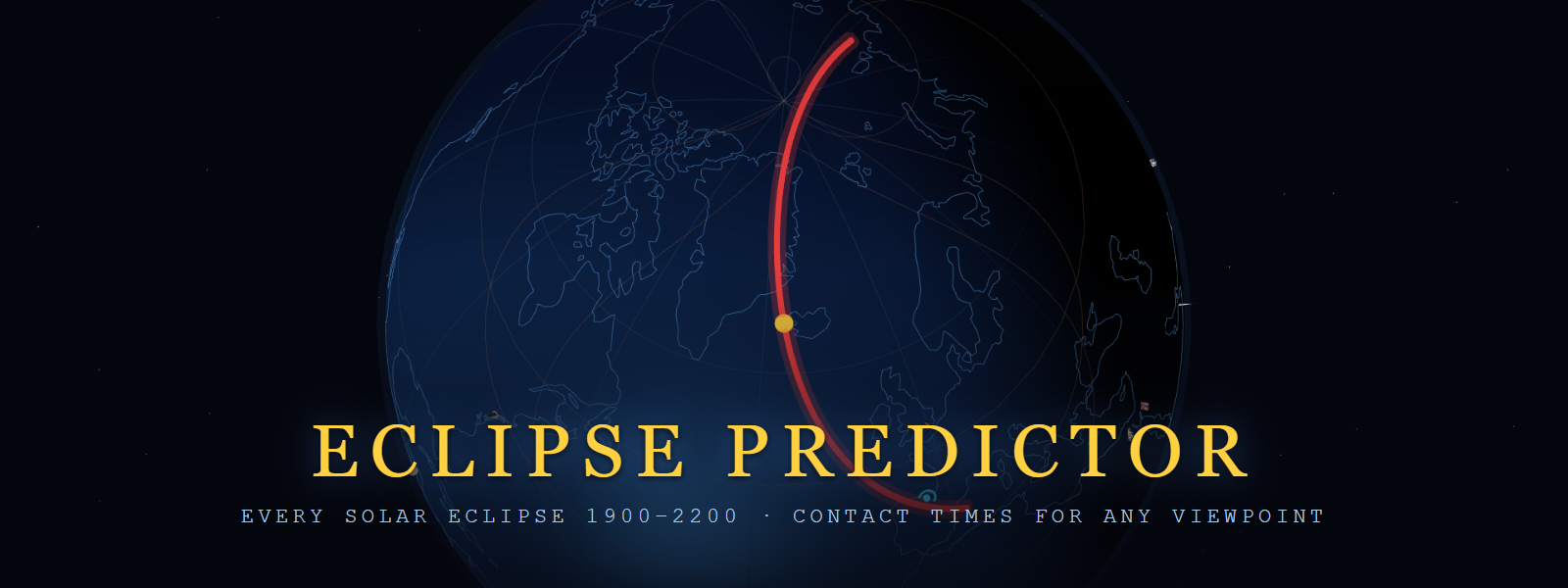
Eclipse Predictor
Eclipse Predictor is a planning tool for people who travel to stand in the Moon's shadow.
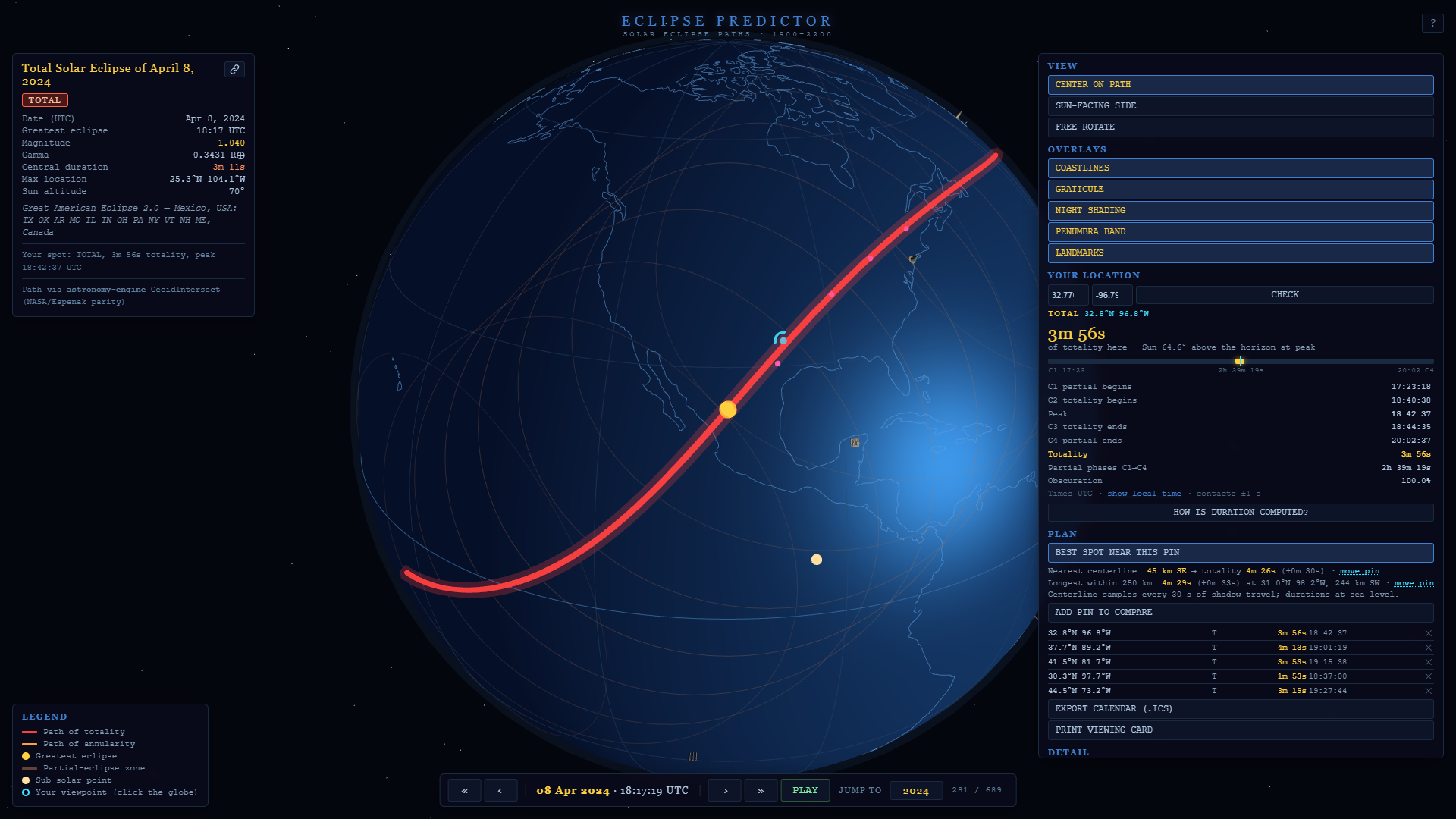
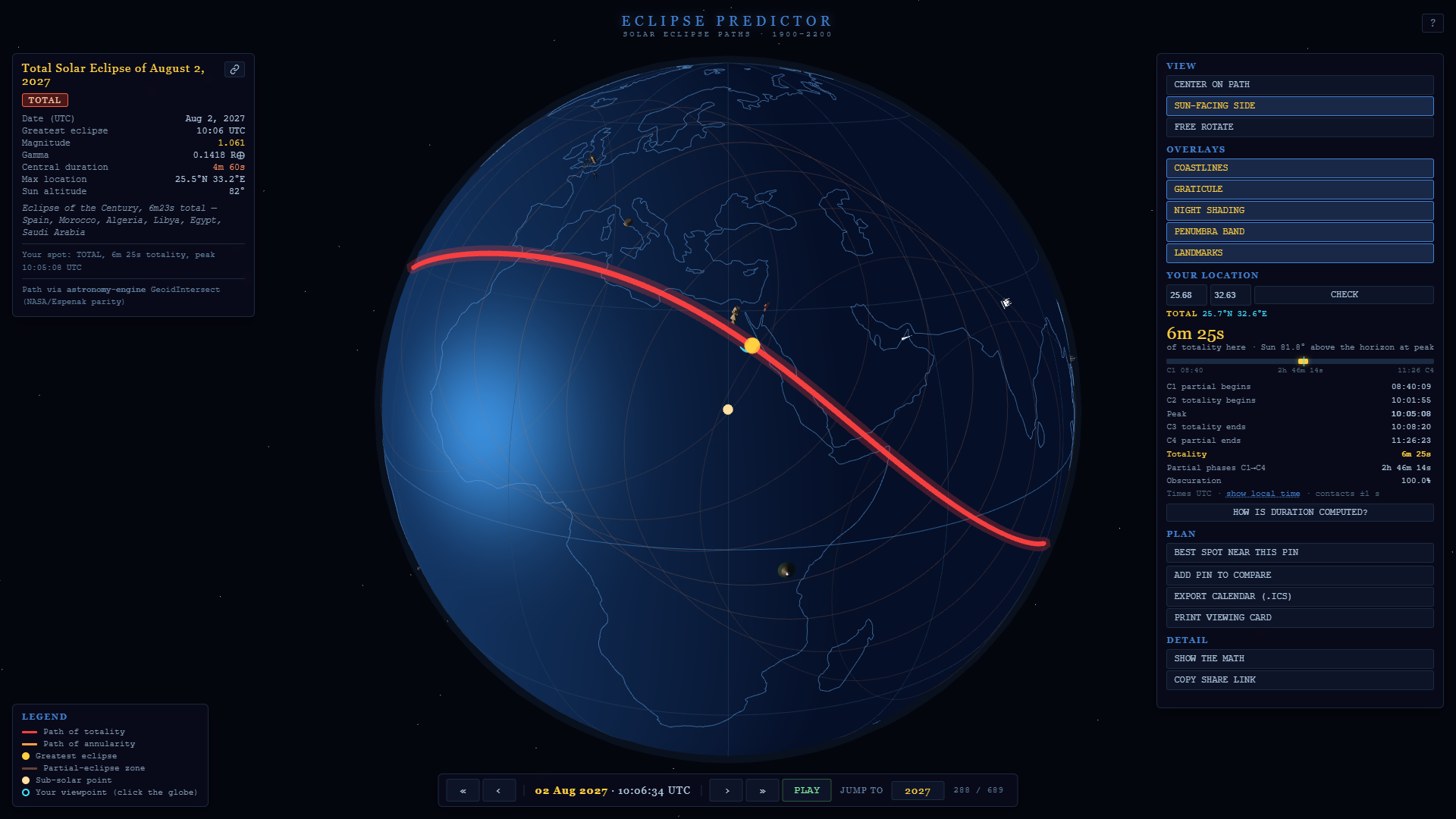
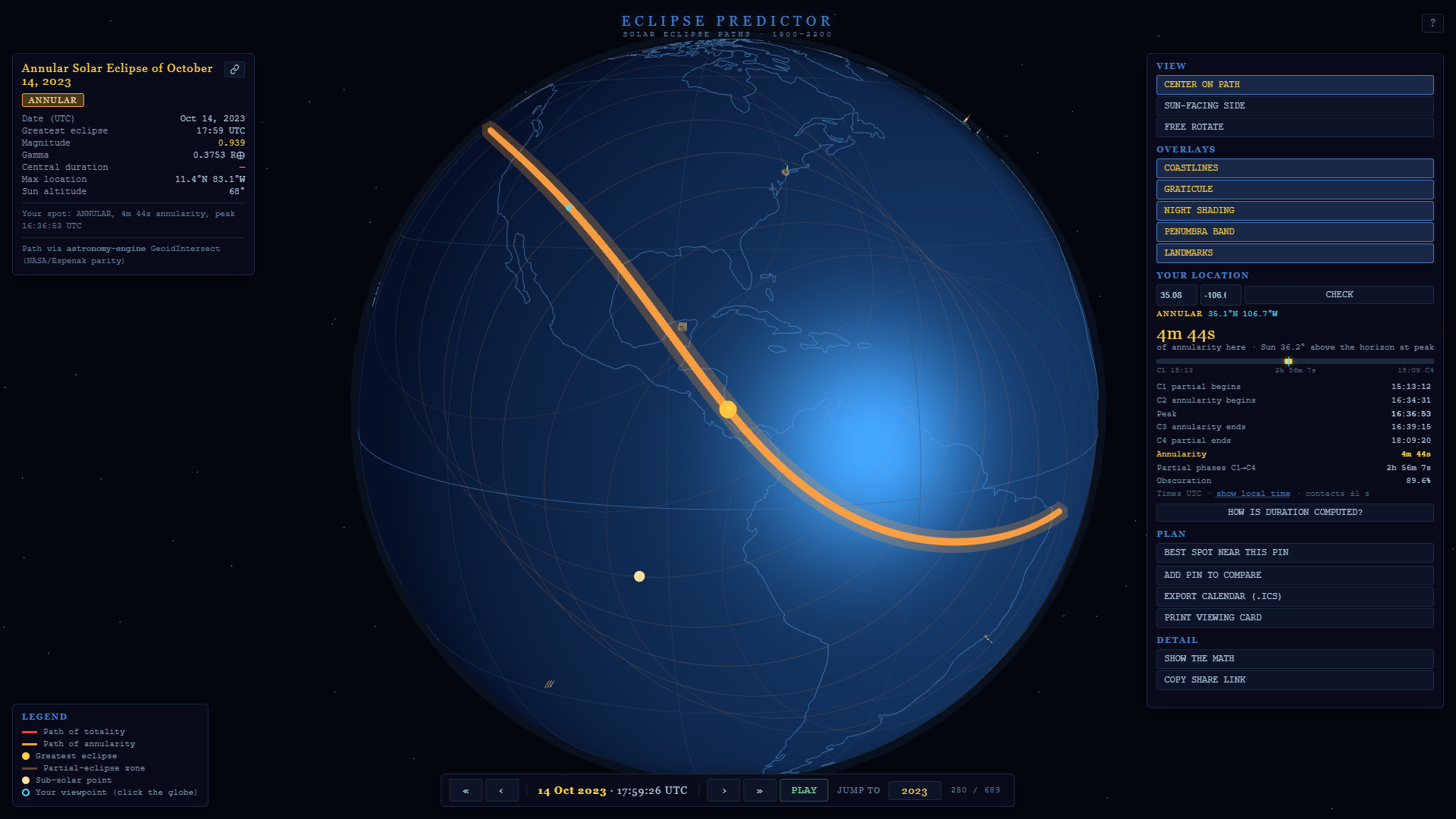
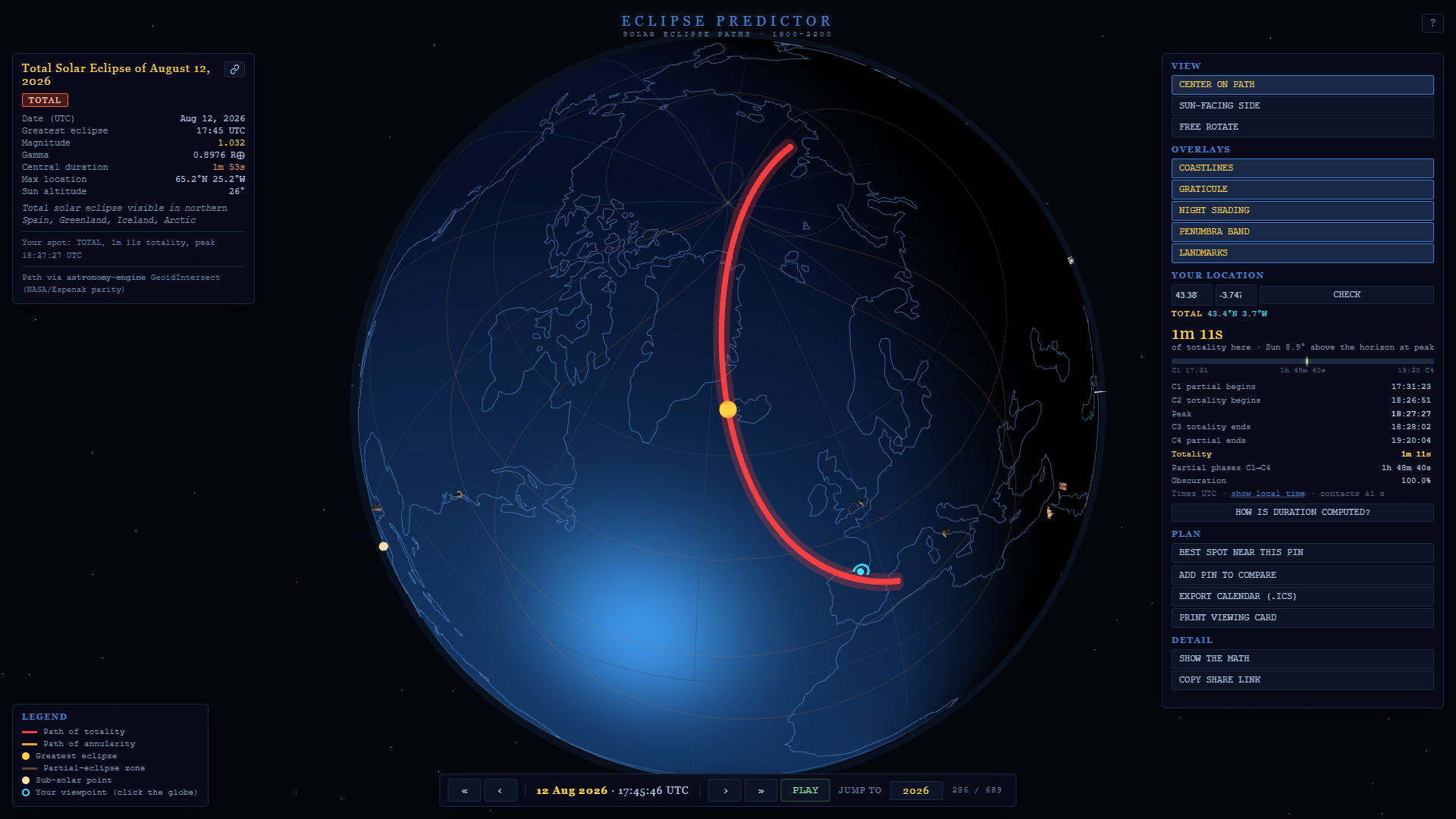
Step through about 690 solar eclipses between 1900 and 2200, each computed on the fly with astronomy-engine (the open-source port of Steve Moshier's ephemeris, sub-arcsecond accurate) and drawn as a path of totality on a rotatable 3D Earth. Then click the spot where you plan to be.
Play the free version right here in the browser: every eclipse, every path, and the contact times for one viewpoint at a time. The desktop download adds the planning tools below and works offline.
For any viewpoint you get
- The four contact times (C1 partial begins, C2 totality begins, maximum, C3 totality ends, C4 partial ends) in UTC or your local time.
- How long totality or annularity lasts there, to the second, and how long the partial phases run.
- Obscuration and the Sun's altitude at maximum, with contacts below the horizon flagged.
- A timeline strip showing the short window of totality inside the hours of partial eclipse.
Planning tools (desktop app)
- Best spot near this pin: the nearest point on the centerline and the longest totality within 250 km, with distance and bearing, and a one-click move.
- Compare: keep up to eight viewpoints in a table that re-evaluates for whichever eclipse is showing. Ask "which of my five candidate towns does best in 2027?" in one glance.
- Calendar export: an .ics file with one event per contact, reminders before first contact and before totality, and the coordinates attached.
- Viewing card: a one-page printout with the contacts in UTC and local time for the glove box.
Transparent math
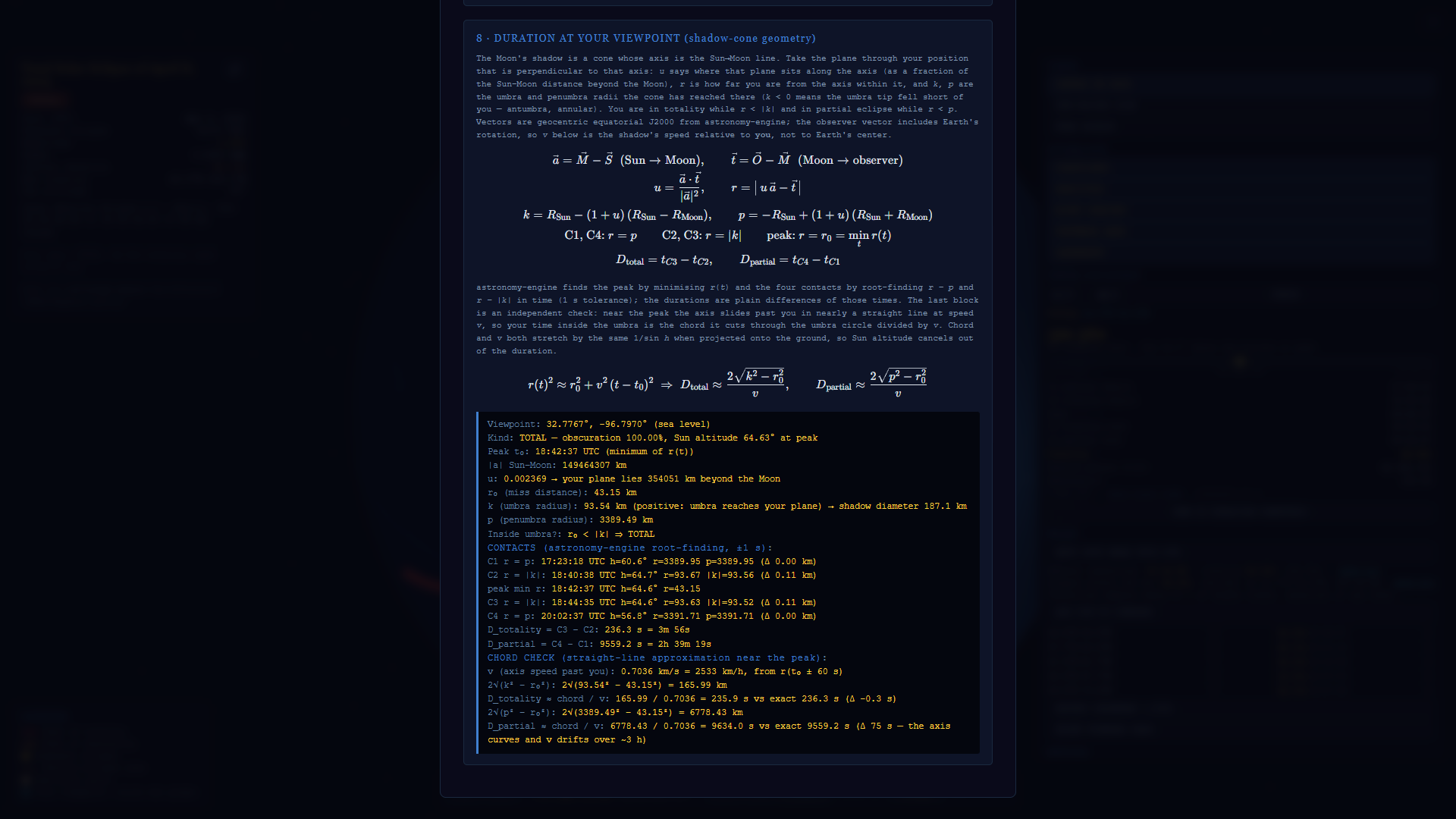
Every number can be traced. "How is duration computed?" opens the shadow-cone derivation for your viewpoint: your distance from the shadow axis against the umbra and penumbra radii, the contact residuals from the root-finding, and an independent chord-over-speed estimate that reproduces the result.
Accuracy
Catalog dates, types, and greatest-eclipse circumstances match NASA's Five Millennium Canon. Central paths land within a kilometre or two on the ground. Local contact times agree with published NASA and Espenak circumstances to a few seconds (sea-level observer, no lunar-limb corrections). Cross-check anything you will bet a trip on with eclipse.gsfc.nasa.gov, and never look at the partial phases without a solar filter.
Also
- Works offline. No account, no telemetry.
- Shareable deep links (#2027-08-02@25.69,32.64) that carry the eclipse and the viewpoint.
- Keyboard driven: arrows step eclipses, Home/End jump to the ends of the catalog.
Built by a practising civil engineer who chased the 2026 eclipse across northern Spain and wanted to know, to the second, what the family would see from the farmhouse. Also free on the web at boardgaminghub.com/eclipsepredictor; MIT-licensed source on GitHub; for a single location and date without the globe, see the eclipse sun position calculator.
Positions from astronomy-engine (Don Cross, MIT). Globe rendered with three.js. Coastlines from world-atlas. Formulas typeset with KaTeX.
Purchase
In order to download this tool you must purchase it at or above the minimum price of $4.99 USD. You will get access to the following files:
Development log
Leave a comment
Log in with itch.io to leave a comment.